The mother who waited 37 years for the truth about Elizabeth Short
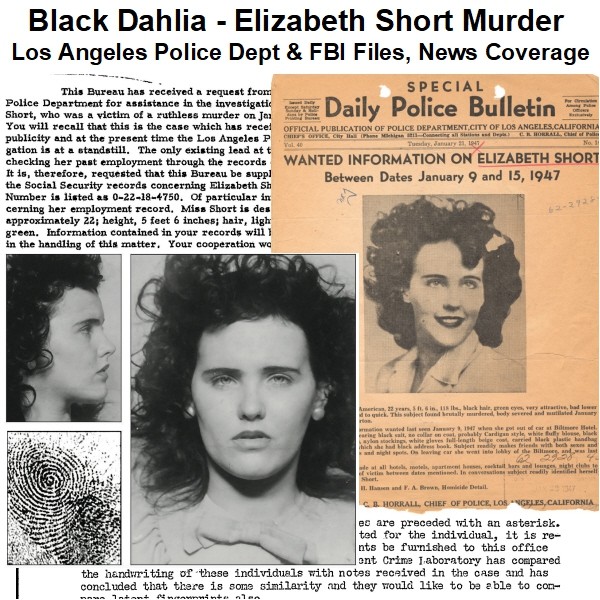
The morning of January 15, 1947, a woman’s body lay in a vacant lot on Norton Avenue in the Leimert Park area of Los Angeles.
The body was nude, severed at the waist, and drained of blood.
The two sections had been placed neatly apart, as if arranged.
The victim had been beaten, and her mouth was slashed from ear to ear.
She was identified through fingerprints as 22-year-old Elizabeth Short.
In Los Angeles social circles, she was known as the “Black Dahlia.”
Who was she?
Who did this to her?
The killer’s identity is not established.
No one was ever charged, and the case remains officially open.
That is what the record shows.
THE DAUGHTER FROM MASSACHUSETTS
Elizabeth Short was 22 years old, a woman from Massachusetts who had come to California looking for work and a film career.
She wore black clothing, and acquaintances called her the "Black Dahlia."
The name was a nickname, not a diagnosis, not a clue to anything the record resolves.
Her mother, Phoebe Short, was in Massachusetts when the news came.
A daughter was dead.
Phoebe Short was notified of her daughter's death, and that is where the record places her — waiting, in Massachusetts, while the investigation unfolded three thousand miles away.
Elizabeth's father had been estranged from the family for years.
The exact nature of that relationship is not detailed in the record.
A sister also survived her.
No one was ever charged with the murder.
The ordinary hopes are the documented ones: work, a film career, California.
She was known for what she wore.
She was known for what she was called.
She was known, in the end, for how she was found.
Her mother waited.
Phoebe Short would wait 37 years, until 1984, without seeing the case solved.
That is the weight of it: a mother in Massachusetts, a daughter in a vacant lot, and a file that stayed open.
THE INTERVIEWS AND THE CONFESSIONS
The investigation was hampered from the start.
There were no witnesses, and the physical evidence was thin.
The body had been washed clean of blood, and no weapon was ever found.
Detectives interviewed hundreds of people.
One of them was Robert “Red” Manley, the man who had driven Short to Los Angeles from San Diego days before her death.

He passed polygraph tests.
He was released.
More than 50 people confessed to the murder.
None of them could provide details that matched the crime scene.
No confession was substantiated, and no weapon was found.
The Los Angeles County district attorney’s office reviewed the evidence.
It found no viable suspect.
The case circled, and it circled, and it never landed.
Each confession raised a hope that collapsed under the same weight: the details did not fit.
The record shows dozens of people who said they did it, and it shows a crime scene that none of them could describe.
The file stayed open because the evidence stayed silent.
A mother in Massachusetts waited, and the investigation kept turning over the same ground.
Not because the detectives were careless.
But because there was nothing to hold onto.
The body had been cleaned, the weapon had vanished, and the people who came forward brought stories, not proof.
What remains is a list of interviews.
What remains is a list of confessions that went nowhere.
What remains is an open file.
THE TWO STORIES OF THE SAME FACTS
There is a story the public wanted.
It is the story of a jilted lover, a figure from her Los Angeles social circle, someone who knew Elizabeth Short and turned on her.
The media pushed that interpretation for decades.
It made sense to people, because a stranger who does that leaves something behind.
It is also a story the record does not support.
The investigators held a different interpretation.
They held that the killer was a stranger who left no trace.
They had no witnesses.
They had no weapon.
They had a body washed clean of blood.
Neither interpretation is established by the record.
The killer's identity is unknown.
That is not a failure of the detectives.
It is a fact of the file.
More than 50 people confessed to the murder.
None could provide details that matched the crime scene.
The district attorney's office reviewed the evidence.
It found no viable suspect.
There was no trial.
No one was ever charged.
The case file remained open for decades, with periodic re-investigations.
No arrest was ever made.
The case remains officially unsolved.
Phoebe Short waited 37 years for the truth about her daughter.
She died in 1984 without seeing it.
The public needed a story.
The investigators needed proof.
The record has neither.
AND THE STORY STILL ISN'T OVER
The case is still listed as open.
The Los Angeles Police Department still lists the Black Dahlia case as open, and cold-case units have revisited it.
No definitive suspect has ever been identified.
No one was ever charged.
Phoebe Short waited 37 years.
She died in 1984 without seeing the case solved.
Her daughter's murder had become one of the most famous unsolved crimes in American history, and she carried that weight to her grave.
Books, films, and documentaries have speculated about the killer for decades.
Theories name names.
Theories build timelines.
Theories assign motives.
The record does not.
The file remains open, and the next concrete step is not specified in the record.
There is no announced new development.
The case is a story that keeps being retold, but the telling has never changed the outcome.
Phoebe Short was the mother who waited.
She was also the mother who never got an answer.
The public needed a story.
The investigators needed proof.
The record has neither.
The case remains open.
The mother is gone.
The daughter's name endures.
Advertisement
You may also like
The trucker's tip that ended the 2002 D.C. sniper attacks — and the bus driver whose death broke the case
The truck driver heard the radio mention a blue Chevrolet Caprice. He was at a rest stop near Myersville, Maryland, when he saw it.…
The tip that ended a three-week sniper terror — a rest stop on I-70
October 24, 2002: a tipster picked up the phone. The call alerted police to a white Chevrolet Caprice parked at a rest stop on…
Who was Hae Min Lee? A track star's last day and the family still seeking answers
The bell rang at Woodlawn High School on January 13, 1999, and Hae Min Lee walked out of class. She was 18, a senior,…
The witness who changed his story four times before Adnan Syed's murder trial
He told police he helped bury Hae Min Lee. He told them Adnan Syed showed him the body. Jay Wilds was the state's key…
The 31-day gap between Caylee Anthony's last sighting and the 911 call that started it all
June 16, 2008, is the last day Casey Anthony said she saw her daughter. She told investigators that date. She said the child was…
The pillowcase over Polly Klaas's head — and the 10:30 p.m. knock her friends never forgot
The knock at the door came at 10:30 p.m. It was October 1, 1993, and twelve-year-old Polly Klaas was having a slumber party with…