The note that bought a one-way ticket to nowhere: D.B. Cooper’s 1971 demand
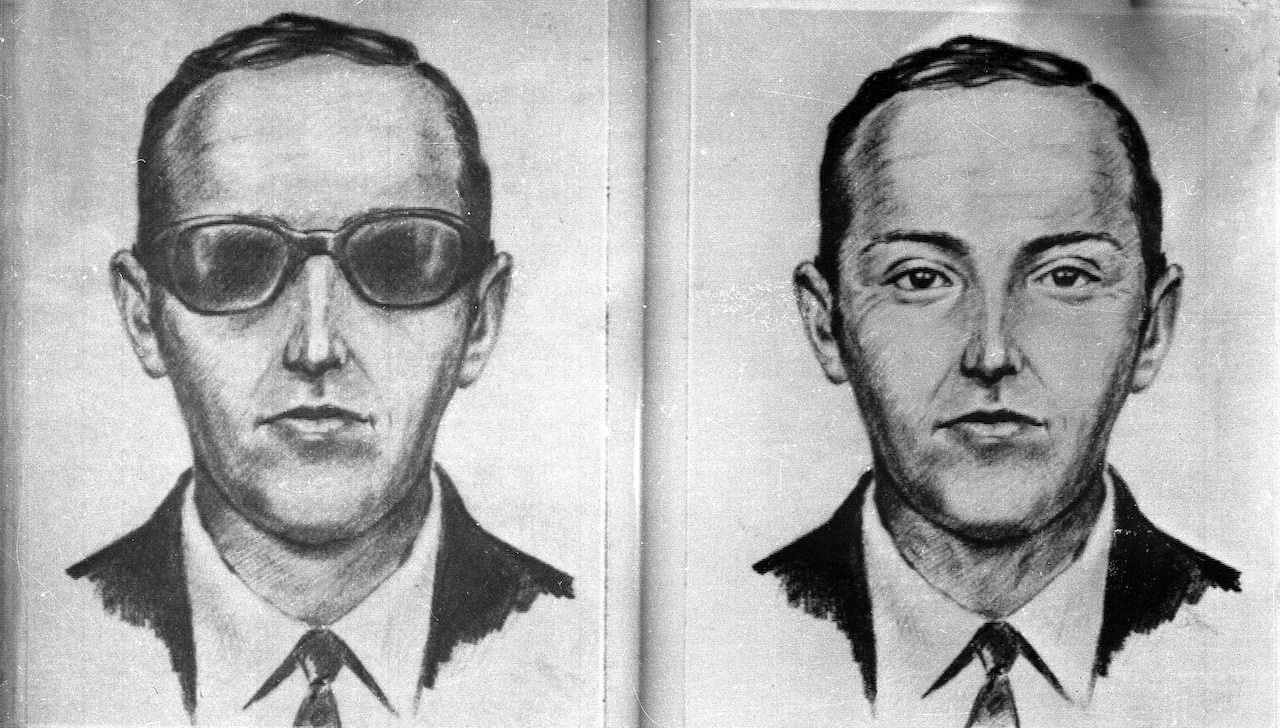
The note was folded, passed hand to hand at 8,000 feet.
November 24, 1971. A man calling himself Dan Cooper bought a one-way ticket on Northwest Orient Airlines Flight 305 from Portland to Seattle.
He wore a dark suit. He carried a briefcase.
Shortly after takeoff, he handed the flight attendant a note.
The note said he had a bomb in the briefcase.
It demanded $200,000 in cash. It demanded four parachutes. It demanded a fuel truck waiting in Seattle.
She read it, and she read it again, because he did not look like a man who would hijack a plane.
He told her he was not joking.
The bomb was never verified. No explosive device was ever found or confirmed, and the record does not establish that one existed.
What the record establishes is the note, the demand, and the quiet calm of the man who passed them.
He was not D.B. Cooper. That name came later, from a reporter's miscommunication, confusing the alias Dan Cooper with someone else.
The incorrect name stuck.
So the man in seat 18C became a legend he never chose.
Who was he?
That is the question the case leaves open.
The note survived. The tie he left behind survived. The parachutes he did not use survived.
The man did not.
The record does not establish his identity. It does not establish his real name, his past, or what pushed him to that seat on that flight.
It establishes only the note, the demand, and the jump into history.
THE DEMAND
Seattle came up through the clouds, and the man with the briefcase stood.
He had released them all — every passenger, every crew member except the pilots.
The plane sat on the tarmac, and one by one they walked off into the rain.
Then the stairs came up, and the door sealed, and the man was alone with the cockpit.
He ordered the pilots to fly toward Mexico City.
The captain was a man named William Scott, named in press reports.
The first officer was William Rataczak, also named in press reports.
The flight attendant who had taken the note from his hand was Florence Schaffner, later identified in the news.
She was gone now, off the plane, standing on the wet concrete with the other released.
What the note said exactly is not in the record.
The record holds only its demands: the money, the parachutes, the fuel truck.
The pilots climbed, and the plane turned south.
The man sat in the back with his briefcase and his claim of a bomb that was never verified.
No explosive device was ever found.
He left behind the note.
He left behind a tie.
He left behind four parachutes, three of them unused, and a question that has never been answered.
The passengers were free.
The crew was not.
They flew toward Mexico City, and the man did not say where he wanted to go from there.
He said only that he wanted to go somewhere.
That is the part the record cannot fill in.
THE JUMP
He jumped from the rear stairway of the Boeing 727 somewhere over southwestern Washington.
He had the money and the parachutes with him.
The plane was still flying toward Mexico City when the crew noticed he was gone.
He was never found.
He was never identified.
The FBI distributed the list of serial numbers to banks and financial institutions across the country.
Every $20 bill in the $200,000 ransom was recorded before it was handed over.
That list was the only trail the money left behind.
Ralph Himmelsbach was the FBI's lead agent on the case.
He became the public face of the investigation.
He later wrote a book about it.
He remained convinced the hijacker likely did not survive the jump.
The FBI conducted one of its longest and most expensive investigations.
The case was never solved.
The jump itself is the part the record cannot fill in.
Whether Cooper survived is unknown.
The FBI has not endorsed any specific theory about what happened after he left the plane.
The audacity of the escape is documented.
The landing is not.
No body was ever recovered.
No parachute was ever recovered.
No further evidence was ever found.
The serial numbers of a few bills surfaced in 1980, on a sandbar of the Columbia River.
That was years later, and miles downstream.
The rest of the money never appeared.
The man who bought a one-way ticket to Seattle simply vanished into the night air over Washington.
That is what the record shows.
That is all the record shows.
THE MONEY
Eight years after the jump, a boy named Brian Ingram was playing on a sandbar of the Columbia River near Vancouver, Washington.
He found a bundle of cash, badly deteriorated, half-buried in the mud.
The serial numbers matched the ransom money.
That was the first and only physical trace of the $200,000 that ever surfaced.
The FBI concluded the money had washed downstream from where Cooper likely landed.
That conclusion is an inference.
How the money reached the sandbar is not definitively established.
No body was found.
No further evidence was found.
The discovery was proof that Cooper existed, that the hijacking happened, that the money was real.
It was also proof that the trail ended there.
A legal fight followed, not over a crime, but over the bills themselves.
The FBI claimed the money.
Northwest Orient Airlines claimed the money.
Ingram's family claimed the money.
The matter was settled out of court in 1983.
Ingram received a portion of the recovered bills.
The rest was divided between the airline and the FBI.
No criminal charges were ever filed against anyone in connection with the hijacking.
There was no trial, because there was no suspect.
The money was tangible. The man was not.
The serial numbers matched. The identity did not.
AND THE STORY STILL ISN'T OVER
The case remains officially unsolved.
The FBI closed its active investigation in 2016, though the agency has said it will continue to review credible leads.
No one has ever been arrested.
No one has ever been convicted.
D.B. Cooper's identity remains unknown.
The recovered ransom money — a small portion of the original $200,000 — is held partly by the FBI and partly by the Ingram family.
The rest of the $200,000 went with him into the dark.
Whether he survived the jump is unknown.
The FBI has stated that the hijacker's fate — whether he survived — is not established, and the agency has not endorsed any specific theory.
Not because the evidence points another way.
Because the evidence points nowhere.
The case has become a cultural legend.
Books examine it.
Documentaries examine it.
Films examine it.
The flight attendant who took the note told her story.
The captain who flew the plane told his.
The lead detective retired and wrote his own book, convinced the hijacker likely did not survive.
But conviction is not proof.
The serial numbers matched.
The identity did not.
There was no trial, because there was no suspect.
There is no closure, because there is no body.
There is no answer, because there is no record.
That would require evidence.
The money was tangible.
The man was not.
The case remains officially unsolved.
Advertisement
You may also like
The misread clue that derailed the Tate murder probe for months
Five people were found dead at 10050 Cielo Drive in Benedict Canyon on the morning of August 10, 1969. Among them was actress Sharon…
The work truck and the oilfield: how a Colorado husband's story collapsed in three days
The friend called it in on the morning of August 13, 2018, after Shanann Watts missed a doctor’s appointment. She was 34, and her…
The Gulf War veteran who rented a Ryder truck under a false name — then a trooper pulled him over
The Ryder truck was rented from an agency in Junction City, Kansas, under the name "Robert Kling." That name was not his. The rental…
Why Gary Ridgway's 48 life sentences still face a painful, unfinished chapter for victims' families
He sat in a King County courtroom in 2003 and said the words that ended the longest murder investigation in Washington state history. Gary…
The 2020 ruling that spared Scott Peterson from death row
She was twenty-seven and eight months pregnant, and she vanished from her home on Christmas Eve. Her husband reported her missing that evening. He…
The 31 days Casey Anthony never reported her toddler missing
The 911 call came from a house in Orlando, Florida, on July 15, 2008. Cindy Anthony was on the line, and she told the…