The parachute jump that left an FBI agent chasing a name that never existed
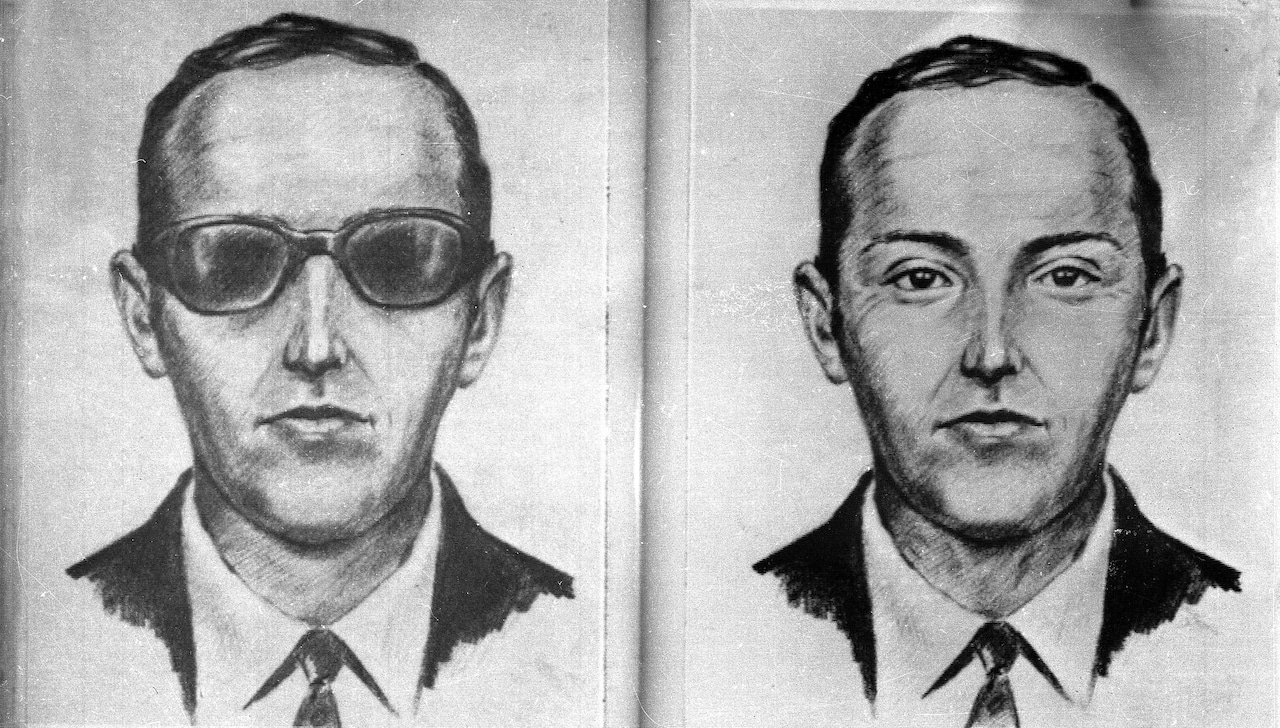
The note was passed on the evening of November 24, 1971.
A man bought a one-way ticket on Northwest Orient Airlines Flight 305, from Portland, Oregon, to Seattle, Washington.
He gave his name as Dan Cooper.
Shortly after takeoff, he handed a flight attendant a note.
The note claimed he had a bomb in his briefcase.
He demanded $200,000 in cash.
He demanded four parachutes.
He demanded a fuel truck standing by in Seattle.
The man who wrote that note called himself Dan Cooper.
The name that stuck in the headlines was different: D.B. Cooper.
That is a wire-service error, a theory in media, not a fact established by the record.
What the record shows is a man who said his name was Dan Cooper.
What the record does not show is who he actually was.
His true identity is not established.
No one knows the face behind the alias.
No one knows the name his mother gave him.
No one knows if the bomb in the briefcase was ever real — no explosive device was ever found or confirmed.
The plane kept flying.
The note had already changed everything.
THE LANDING
The plane touched down at Seattle-Tacoma Airport.
The passengers were released.
The ransom and the parachutes were delivered.
Cooper then ordered the crew to fly toward Mexico City.
The flight attendant who had taken the note dealt with him directly; she became a key witness.
Her name is not in the record for this article.
The plane climbed back into the night.
The threat was still in the cabin.
The bomb in the briefcase had not been confirmed as real.
No explosive device was ever found.
The crew flew south, following his orders.
The exact location of the jump is not established.
It is described as somewhere between Seattle and Reno, likely over southwestern Washington or northwestern Oregon.
The plane landed safely in Reno.
The crew was unharmed.
The passengers were safe.
The man was gone.
The money was gone with him.
The mystery had only just begun.
THE JUMP
Somewhere between Seattle and Reno, Nevada, Cooper opened the rear stairway and jumped into the night.
The plane landed safely in Reno.
The crew was unharmed.
He was never seen again.
That much the record establishes.
Whether Cooper survived the jump is not established.
The record only confirms he was never seen again.
The FBI immediately took over the case.
Ralph Himmelsbach led the investigation.
He worked it for years.
The ransom money came with a trail.
The serial numbers on the bills were recorded before they were handed over.
The FBI distributed that list to banks and businesses.
Anyone spending a marked bill would be caught.
No one was.
The parachutes were standard-issue.
They provided no unique leads.
The note Cooper handed the flight attendant yielded no usable fingerprints.
His tie, left on the plane, yielded nothing at the time.
Later DNA testing in 2001 on the tie was inconclusive.
Not because the science was weak.
Because the sample was too small, too degraded, too old.
The physical evidence was a closed door.
The FBI searched the terrain below the flight path.
They found no body.
They found no parachute.
They found no bag of cash.
Ralph Himmelsbach kept the file open.
He chased suspects for years.
He cleared them all.
The man who jumped had a name he gave: Dan Cooper.
That name was real to him.
It was not real to the record.
The man who jumped was never seen again.
The case was left with a question mark where a name should be.
THE MONEY
In 1980, a boy found $5,800 in deteriorated bills on a sandbar on the Columbia River near Vancouver, Washington.
The serial numbers matched the ransom money.
That was the first physical proof that Cooper had survived the jump.
It was proof the money had entered the river.
The FBI conducted extensive searches of the terrain.
They found no body.
They found no remaining cash.
Over the years, the FBI investigated hundreds of suspects.
One was a man convicted of a nearly identical hijacking in 1972.
He was never tied to the Cooper case.
Another was a deathbed claimant who said he was Cooper.
The FBI did not confirm it.
The name of the boy who found the money is not in the record for this article.
The name of the deathbed claimant is not in the record either.
No one was ever charged.
No victim was harmed.
The money was real.
The trail was not.
AND THE STORY STILL ISN'T OVER
In 2016, the FBI closed its active investigation.
The bureau cited the passage of time and the exhaustion of leads.
The case remains officially unsolved.
The FBI still accepts credible tips, the record states.
No new leads are in the record.
The case is closed but not resolved.
The hijacker's identity remains unknown.
The remaining ransom money has never been recovered.
It is a closed file. It is also an open wound.
The lead FBI agent retired and wrote about the case before his death.
He worked the investigation for years, according to the record.
He never named the man who jumped.
The case has become a cultural legend.
Annual speculation returns with the weather.
Periodic news coverage reopens the same questions.
No definitive resolution has ever been reached.
The boy who found the money sold a portion of it at auction in 2008.
The serial numbers had matched the ransom, confirming the jump was survived.
The rest of the cash never surfaced.
Not because it was found. Because it was not.
Could a tip change everything?
Could a name finally attach to the alias?
Could the remaining money turn up on another sandbar?
That would require evidence.
The record holds no such evidence.
The man called himself Dan Cooper.
The name "D.B. Cooper" was a wire-service error.
The true identity remains unknown.
The trail went cold in 2016.
The story did not.
Advertisement
You may also like
The tarot card with 'Call me God' — and what it did to the hunt
The card was found at one of the crime scenes, somewhere in the region that stretched across Washington, D.C., Maryland, and Virginia. The exact…
A traffic stop for a missing license plate, and the Oklahoma City bombing timeline takes a turn
9:02 a.m., April 19, 1995. A rented Ryder truck packed with ammonium nitrate and fuel oil exploded in front of the Alfred P. Murrah…
The Zodiac letter that carried a piece of Paul Stine's bloody shirt
The cab driver was 29 years old. He picked up a fare in the heart of San Francisco's Presidio Heights on October 11, 1969.…
The 12:10 a.m. dog-walk discovery that turned a Brentwood street into a media siege
She was just walking her dog. It was approximately 12:10 a.m. on June 12, 1994, and the neighbor was out on Bundy Drive in…
The Green River Killer's truck painter confession that left detectives with 49 names
He painted trucks for a living, a trade that kept his hands steady and his cover plain. Gary Leon Ridgway was a truck painter…
The phone card call that cracked the DC Sniper case — and the white van that led police astray
A tip came from a phone card. A caller used it, and the call led police to a witness who had seen the Chevrolet…