The paymaster's $15,776 payroll — and the widows who testified
The paymaster and the guard were carrying two boxes along Pearl Street, an ordinary errand on an ordinary Thursday.
The boxes held the payroll for the Slater and Morrill shoe factory, about $15,776 in cash.
Two men approached and opened fire.
The guard was shot four times and died at the scene.
The paymaster was shot twice and died later that day.
The gunmen grabbed the boxes, jumped into a waiting Buick driven by a third man, and fled.
Witnesses reported seeing several men in the car.
Who were the two men who stepped out of that car?
Why were they carrying so much cash?
Why those two workers, on that street, at that moment?
The identities of the gunmen are not established at this point in the narrative.
Police later linked the South Braintree robbery to an earlier attempted holdup in Bridgewater, Massachusetts, on December 24, 1919.
In that attempt, a paymaster had escaped unharmed.
The earlier job failed.
The later one did not.
She was on the ground below, or so the scene suggested.
The guard's widow would testify at trial, years later.
The paymaster's widow would testify too.
But on April 15, 1920, that was still ahead of them.
What remained was the street, the boxes, the Buick, and the dead.
THE WIDOWS IN COURT
The paymaster was 42 years old. The guard was 32.
They worked at the Slater and Morrill shoe factory, carrying the payroll in two boxes along Pearl Street. The guard's widow, Vincenzina Berardelli, took the stand at trial. She testified in the same courtroom where the two men charged with the murders sat. The paymaster's widow, Mary Parmenter, also remarried after the events.
She remarried and lived quietly.
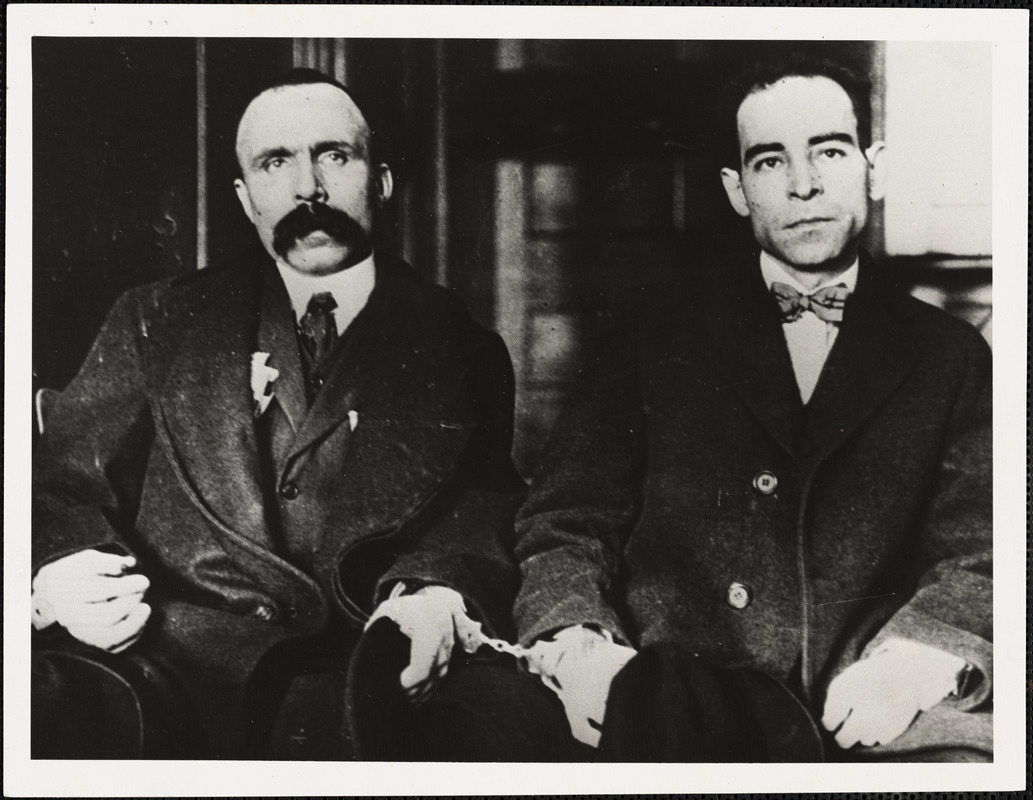
The two men charged with the murders were Nicola Sacco and Bartolomeo Vanzetti. Sacco was a shoe worker. Vanzetti was a fish peddler. Both were Italian-born anarchists and labor activists. The courtroom filled with their politics, their radical circles, their cause. The widows sat through it.
What did Vincenzina Berardelli say on the stand? What words did she choose for the man who was shot four times at the scene? That is not in the record. What Mary Parmenter said is not in the record either. The testimony is documented as having happened; its content is not preserved.
The victims' families received little public attention compared to the defendants. The men charged had protests, intellectuals, and labor groups rallying around them. The widows had the stand, then the quiet.
She was a widow in a courtroom. She was also a footnote in a global cause célèbre. It is one thing to be remembered. It is another to be the reason the trial happened at all.
THE ARREST AND THE EVIDENCE
They were arrested on May 5, 1920, on a streetcar in Brockton.
They were armed with pistols. They were carrying anarchist literature.
They lied to police about where they had been and what they had done. The prosecutor used those lies as evidence of consciousness of guilt. The defense said the lies were fear, not guilt.
The prosecution’s ballistics expert testified that a bullet recovered from the guard’s body was fired from Sacco’s pistol. Defense experts disputed this. The bullet matched, the expert said. The bullet did not match, the defense said. That would require evidence.
A cap found at the scene was a key piece of evidence. Prosecutors claimed it belonged to Sacco. The defense disputed this. Whether the cap belonged to Sacco is not established.
Eyewitnesses placed the men at the scene. Several witnesses gave conflicting accounts. One saw the gunmen. Another saw a different man. Another saw a car. The testimony was documented as having happened; its reliability is not preserved.
What did the guard’s widow think of the cap? What did she make of the bullet?
She was in the courtroom. She had testified.
The men on trial had protests, intellectuals, and labor groups rallying around them. The widows had the stand, then the quiet.
It is one thing to be remembered. It is another to be the reason the trial happened at all.
THE TRIAL AND THE VERDICT
The trial began on May 31, 1921, in Dedham, Massachusetts.
Two men sat in the dock, charged with first-degree murder.
The prosecution said the robbery and the killings were part of an anarchist plot to raise funds.
The defense said mistaken identity.
The defense said there was no motive.
The widows had testified weeks earlier, in the spring.
One spoke about her husband, the guard.
The other spoke about her husband, the paymaster.
Their words were part of the record now.
The jury deliberated.
On July 14, 1921, they found both men guilty of first-degree murder.
The sentence was death.
For six years, the defense filed motions for a new trial.
They cited new evidence.
They cited judicial misconduct.
The judge denied each motion.
In 1925, a convicted murderer on death row confessed to participating in the South Braintree crimes.
The judge dismissed the confession.
Whether the confession was true is not established.
The record does not resolve it.
The case drew international attention.
Protests came from intellectuals and labor groups.
A final appeal went to the governor of Massachusetts.
He appointed an advisory committee.
The committee upheld the verdict.
On August 23, 1927, at Charlestown State Prison, the two men were electrocuted.
The widows had testified.
The men were dead.
The question of guilt remained open.
AND THE STORY STILL ISN'T OVER
The governor’s proclamation came in 1977, fifty years after the executions.
Michael Dukakis, then governor of Massachusetts, declared that Sacco and Vanzetti had been treated unjustly and that their names should be cleared of any disgrace.
He stopped short of a full pardon.
It was a statement of injustice, not a judgment of innocence.
That distinction still matters.
The record shows two men were charged, tried, convicted, and executed.
The record does not show, with certainty, whether they were guilty.
Some scholars since have argued they were.
Others have argued they were not.
The question has never been definitively resolved.
That would require evidence the case does not provide.
The widows had testified, and the widows had remarried.
Vincenzina Berardelli remarried and lived quietly.
Mary Parmenter also remarried.
Their losses received little public attention compared to the men who were executed.
The men were the cause célèbre.
The widows were not.
International attention had been enormous.
Protests and appeals came from figures such as Felix Frankfurter and Albert Einstein.
The case drew a global audience.
The widows' grief was a private matter.
It remains a private matter.
The men were electrocuted on August 23, 1927, at Charlestown State Prison.
The question of what happened in South Braintree on April 15, 1920, was buried with them.
It was not answered.
It has not been answered since.
The governor's proclamation cleared their names of disgrace.
It did not clear the record of doubt.
The doubt is the only thing that has never been executed.
Advertisement
You may also like
The $1 million extortion letter that named the Tylenol killer — and the suspect who was never charged
The letter arrived at Johnson & Johnson in 1982, typed and demanding $1 million to "stop the killings." The killings were the Tylenol poisonings…
The Green Beret doctor who told police four intruders killed his family — then changed his story
The call came in the early hours of February 17, 1970. Military police arrived at the off-post apartment of Army Captain Jeffrey MacDonald at…
The cotton gin fan that pulled Emmett Till's body to the riverbed — and the case history still written in it
The fan came up with the body. On August 31, 1955, Emmett Till was pulled from the Tallahatchie River. A cotton gin fan was…
The 1954 murder that a Supreme Court ruling tied to a media circus
The intruder came through the bedroom door sometime before dawn. It was July 4, 1954, in Bay Village, Ohio, a quiet suburb on Lake…
The tarot card left at a D.C. sniper crime scene — and the message police could not decode for weeks
The card was found at one of the crime scenes, a piece of evidence among shell casings and police tape. It carried a message…
The mother who demanded justice after the last Son of Sam killing
The parking ticket was found near the last shooting scene. It was traced to a car registered to David Berkowitz. That is how the…