The pregnant widow who learned of Buddy Holly's death — and what she lost next
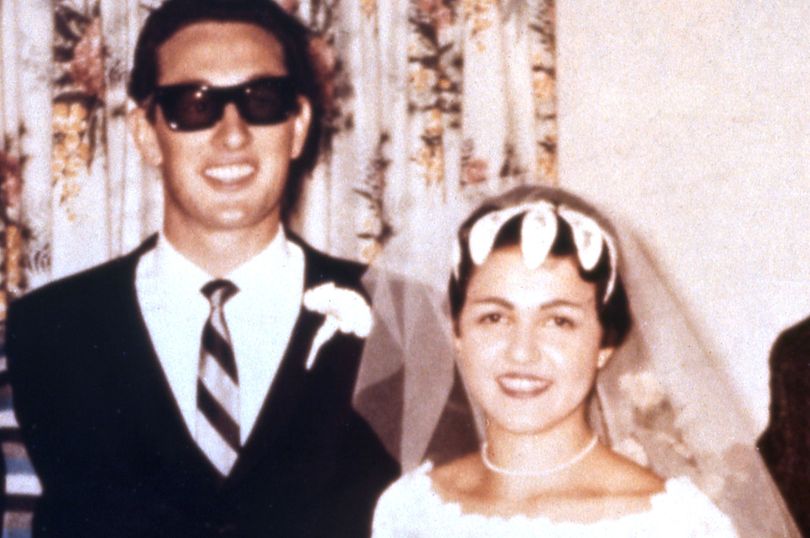
She was twenty-one years old and pregnant.
The news came by telephone.
María Elena Holly learned of her husband's death that way, the source says, though it does not describe the moment itself.
The exact circumstances of how she heard the crash were not recorded.
What is recorded is the date: February 3, 1959.
On that day, a small Beechcraft Bonanza crashed in a snowy cornfield near Clear Lake, Iowa, killing all three passengers and the pilot.
The passengers were Buddy Holly, Ritchie Valens, and the third musician on the tour.
The pilot was twenty-one years old, the same age she was.
María Elena was Buddy Holly's widow.
She was pregnant when she learned he was gone.
She miscarried shortly after learning of his death.
The source states this plainly, with no further detail.
No detail about the hospital. No detail about the days that followed.
What remains is the fact of the loss, stacked on the loss.
The crash had taken her husband. The news had taken the child.
She was on the ground below the news.
That is what the record holds: a phone call, a pregnancy, a miscarriage, a date.
The date is February 3, 1959.
The place is Clear Lake, Iowa.
The dead are three musicians and the pilot who flew them.
The widow was left with a name and a date and a silence where the details should be.
THE NIGHT BEFORE
The night of February 2, 1959, the Surf Ballroom in Clear Lake was loud with the "Winter Dance Party" tour.
Buddy Holly, 22, was the headliner, a singer-songwriter from Lubbock, Texas, known for "That'll Be the Day" and "Peggy Sue."
Ritchie Valens, 17, was the rising star from Pacoima, California, who had just broken through with "La Bamba."
The Big Bopper, 28, was a Texas disc jockey and singer whose "Chantilly Lace" had made him a name.
They were young, they were touring, and the show was another stop on a long winter run.
After the performance, the three musicians arranged a flight to their next tour stop in Moorhead, Minnesota.
Why they chose to fly rather than take the tour bus is not stated in the source.
The plane was a 1947 Beechcraft Bonanza 35, owned by Dwyer Flying Service.
It was a small aircraft, built for a quick hop, not a night crossing in bad weather.
The pilot took off from Mason City Municipal Airport around 1:00 a.m.
The conditions were poor: light snow, gusty winds, and darkness that closed in fast.
The flight was meant to be short.
The flight was meant to be routine.
The musicians left the warmth of the ballroom and climbed into a cold, dark sky.
They never arrived in Moorhead.
That is where the record stands: a show, a decision, a takeoff at one in the morning.
The rest is a crash site in a snowy cornfield, found the next morning.
THE MORNING AFTER
The wreckage was found the next morning by the plane's owner, Dwyer Flying Service.
The musicians had failed to arrive in Moorhead.
The crash site was a snowy cornfield about five miles northwest of the Mason City airport.
The Civil Aeronautics Board opened its investigation.
The lead investigator determined the probable cause: pilot error.
The pilot became disoriented in poor visibility and darkness.
The investigation found he had not been properly trained on the aircraft's gyroscopic instruments.
The new attitude indicator was singled out.
No mechanical failure was found in the aircraft.
The CAB's report, released later in 1959, cited the pilot's lack of instrument experience as a key factor.
What time the plane went down?
What the pilot saw in those final moments?
What he tried before the plane hit?
The record does not establish the exact time of the crash.
The record does not establish the precise sequence of events in the cockpit.
It establishes a takeoff at one in the morning.
It establishes a snowy field found by daylight.
It establishes an official finding of pilot error and adverse weather.
THE OFFICIAL FINDING
The Civil Aeronautics Board ruled the crash an accident.
The cause, the board found, was pilot error and adverse weather.
No criminal charges were filed against anyone.
The pilot's family maintained he was not at fault.
The official report attributed the crash to his error.
That tension never resolved in public.
Civil lawsuits from the victims' families followed.
They were filed against the flying service and the pilot's estate.
The cases were settled out of court.
The specific terms of those settlements are not in the record.
The families received insurance settlements.
The amounts were not widely reported.
What remains is the official finding and the family's dissent.
What remains is the quiet closure of a settlement.
The crash needed a name.
It became "The Day the Music Died."
That phrase came from Don McLean's 1971 song "American Pie."
It is a cultural memory now, not a legal one.
The record establishes the cause as the board found it.
It does not establish the terms of the settlements.
It does not establish the amounts paid.
It does not establish that anyone was ever held criminally responsible.
Those details were never made public.
The official finding stands.
The family's objection stands beside it.
AND THE STORY STILL ISN'T OVER
The Surf Ballroom in Clear Lake still hosts a memorial concert every February 3.
The crash site has a memorial.
Buddy Holly was inducted into the Rock and Roll Hall of Fame in 1986.
Ritchie Valens followed in 2001.
The Big Bopper was inducted in 1999.
María Elena Holly later established the Buddy Holly Foundation.
She worked to preserve his legacy.
The families of all three musicians have remained involved in the memorial events over the decades.
The pilot is buried in Iowa.
His family maintained he was not at fault.
The official report attributed the crash to his error.
The family's objection stands beside it.
The crash remains one of the most famous tragedies in rock and roll history.
Don McLean's "American Pie" cemented the cultural memory of the event.
The record is administrative and closed.
No further legal or investigative steps are mentioned in the source.
That would require evidence.
The annual concert goes on.
The names are read.
The songs are played.
The story continues through memorials and legacy.
It is a tragedy.
It is also a gathering, every year, in the same ballroom where they played.
Advertisement
You may also like
Why the FBI's tear gas assault on Waco preceded a fire that killed 76 — and who started it remains unknown
On April 19, 1993, FBI armored vehicles punched holes into the walls of the Mount Carmel Center compound near Waco, Texas, and inserted tear…
The desert graves that were found three years after a family vanished
The television was still on. Uneaten dinner sat on the table. The family dog was in the backyard. Both vehicles were still at the…
The false babysitter story that unraveled Casey Anthony's defense
She gave them a name. A babysitter named Zenaida Fernandez-Gonzalez, she told investigators, had taken her daughter. The name was repeated in news coverage.…
How a 14-year-old's open-casket funeral forced a nation to look at Emmett Till
She had the casket opened. Emmett Till's body came back to Chicago from the Tallahatchie River, where it was pulled from the water on…
The package to the Los Angeles Examiner that claimed to hold Black Dahlia clues
The package sat in a pile of mail at the Los Angeles Examiner, unremarkable until someone opened it. Inside were Elizabeth Short's address book…
Inside the taunting Zodiac letter that made a reporter a target
The envelopes arrived at the San Francisco Chronicle with return addresses that did not exist. Inside were letters, each one a taunt, each one…