The ransom note on a windowsill — then a 72-day wait that ended in a woods
The nursery was quiet.
It was the evening of March 1, 1932, and Charles Lindbergh Jr., the 20-month-old son of aviator Charles Lindbergh and Anne Morrow Lindbergh, was in his crib on the second floor of the family home near Hopewell, New Jersey.
At approximately 10:00 p.m., the child's nurse discovered him missing.
She alerted the parents.
On the nursery windowsill sat a handwritten note.
It demanded $50,000.
The room held a crib, an empty space, and a piece of paper.
Who wrote that note is not established by the record at this point in the timeline.
The kidnapping was committed with a homemade wooden ladder, found at the scene.
The weapon was a blunt instrument.
It was never recovered.
The child was gone, taken from a house watched by the most famous man in America.
What happened next would take seventy-two days.
A theory circulating online — that the man executed for this crime was framed — is a claim, not a documented fact.
The record does not establish that.
It shows a note on a sill.
It shows a ladder in the dark.
It shows a family waiting.
Who wrote the demand?
That would require evidence.
THE 72-DAY WAIT
The investigation was led by the New Jersey State Police under Colonel H. Norman Schwarzkopf.
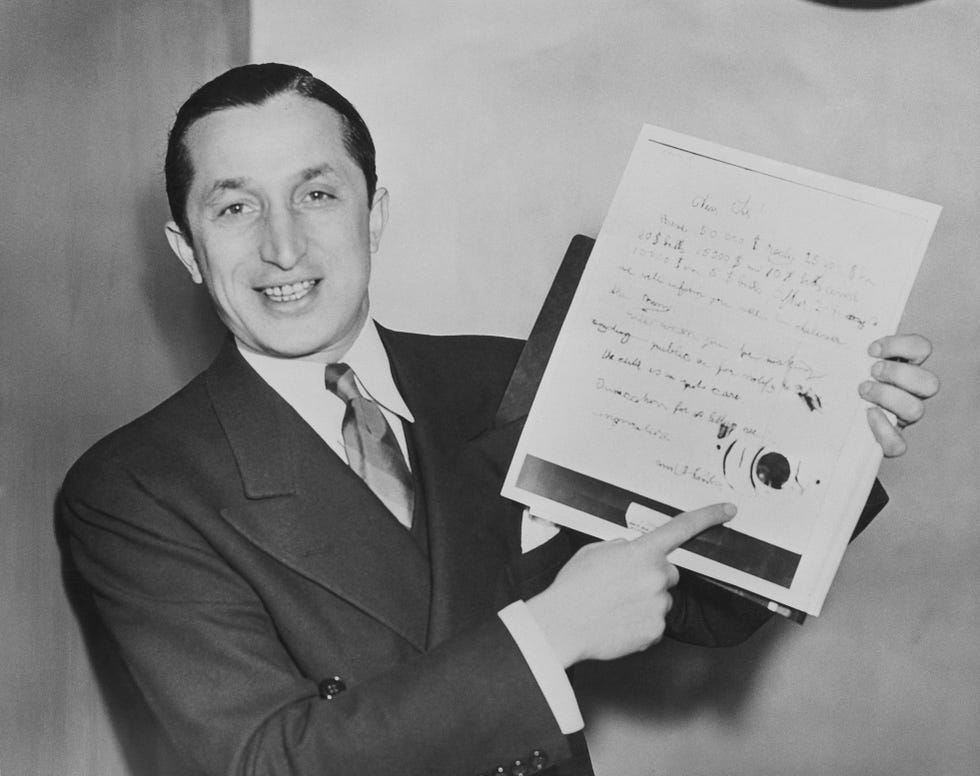
The ransom note was examined for handwriting and paper characteristics.
Dr. John F. Condon, a retired school principal, inserted a newspaper ad offering to act as intermediary.
He subsequently met with a man calling himself "John" in a Bronx cemetery.
Condon handed over $50,000 in gold certificates.
The serial numbers of the ransom bills were recorded.
The family waited.
The police waited.
The country waited.
Who was "John"?
That would require evidence.
What happened to the child between the kidnapping and the discovery of the body is not in the record.
The identity of the man called "John" is not established at this point.
Despite an extensive search and payment of the ransom, the child's body was found on May 12, 1932.
It was in a wooded area about four and a half miles from the Lindbergh home.
The cause of death was a blow to the head.
Seventy-two days had passed since the note appeared on the windowsill.
The hope was gone.
The negotiation was over.

The handoff had been made.
And still, the record holds only what it holds.
THE GAS STATION SERIAL NUMBER
The negotiation was over.
The handoff had been made.
And still, the record holds only what it holds.
In September 1934, a gas station attendant in the Bronx wrote down a license plate.
The driver had paid with a $10 gold certificate from the ransom list.
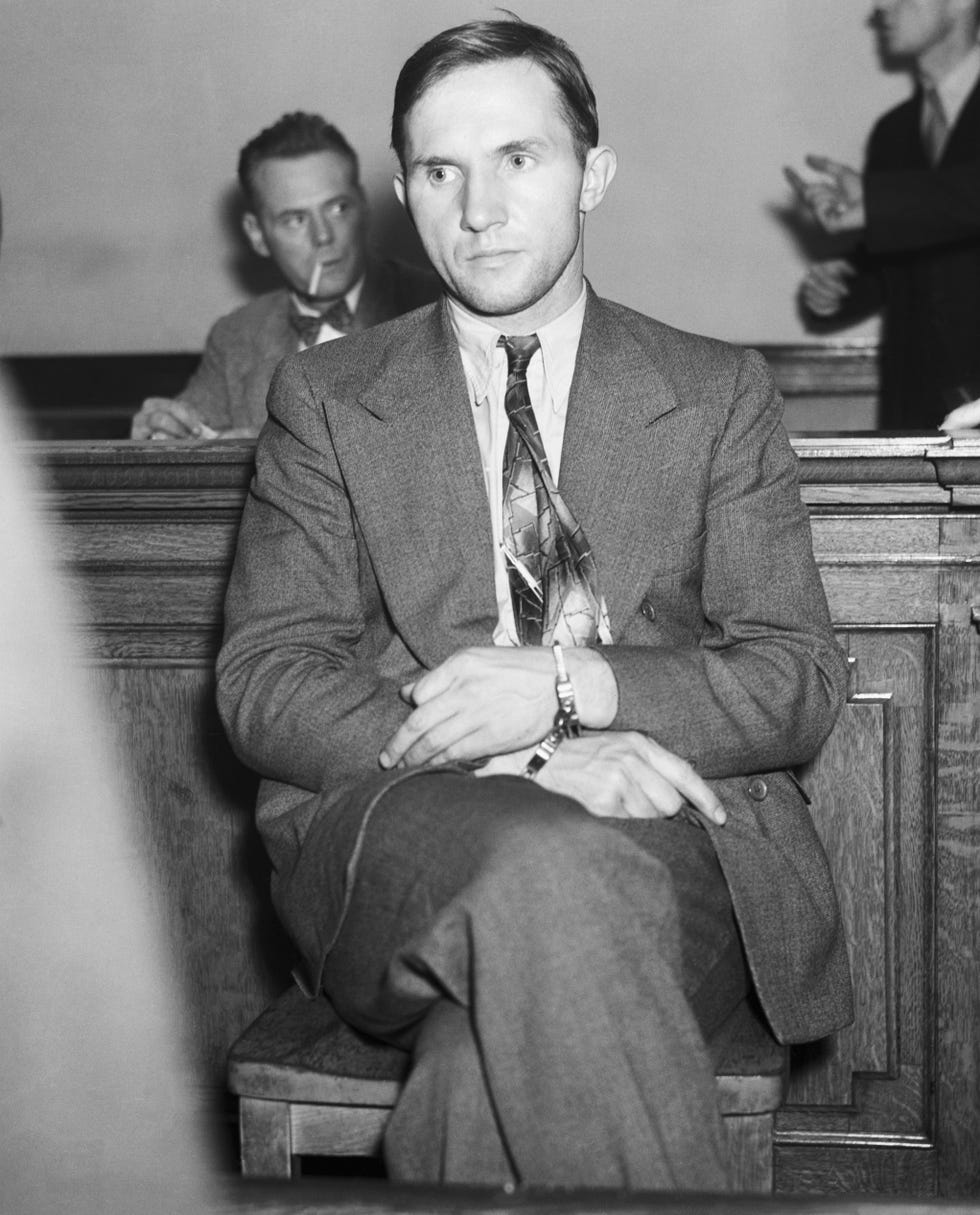
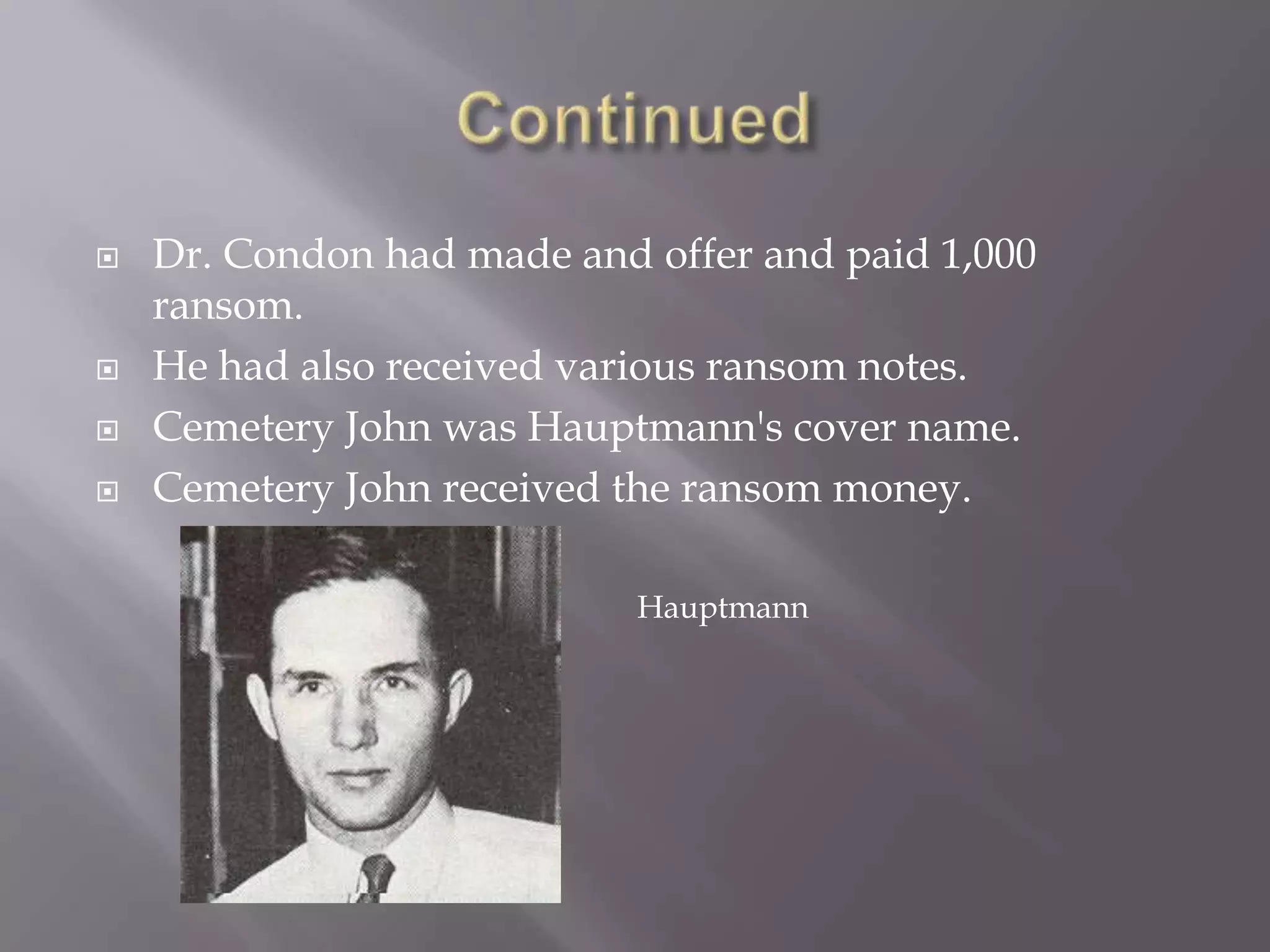
The car was traced to Bruno Richard Hauptmann, a German-born carpenter.
He was arrested that same month.
A search of his home found over $14,000 of the ransom money.
The search also found tools and wood.
The wood matched the ladder used in the kidnapping, according to the investigation.
The ladder itself was a key piece of physical evidence.
Its wood was traced to Hauptmann's attic floorboards.
That tracing is what the record describes.
It is not an absolute proof.
Expert witnesses compared Hauptmann's handwriting to the ransom notes.
They testified to similarities.
Whether Hauptmann was the man in the cemetery is not established by the record.
Whether he wrote the note is not established by the record.
What the record shows is the arrest.
What the record shows is the money.
What the record shows is the wood.
What the record shows is the comparison.
The gas station attendant's notation led to the carpenter.
The carpenter was charged.
The trial would come later.
THE TRIAL AND THE TWO STORIES
The trial opened on January 2, 1935, in Flemington, New Jersey.
The prosecution, led by Attorney General David T. Wilentz, presented over 160 witnesses.
The defense, led by Edward J. Reilly, argued that Hauptmann was innocent.
The evidence was circumstantial, Reilly said — a frame-up, a manufactured case.
There was the ladder, its wood matched to Hauptmann's attic floorboards.
There was the handwriting, compared by experts to the ransom notes.
There was the money, over $14,000 found in his home.
The defense said none of it was enough.
It was a mountain of circumstance against a claim of conspiracy.
Which one did the jury believe?
Which one could they prove?
That would require certainty the record does not give.
Whether the evidence was manufactured is not established by the record.
The verdict is guilty — not a proven fact of guilt beyond all doubt.
The jury deliberated for about 11 hours over two days.
On February 13, 1935, Hauptmann was found guilty of first-degree murder.
He was sentenced to death.
Two irreconcilable stories, one verdict.
The weight of the evidence, or the weight of the accusation.
The jury chose.
AND THE STORY STILL ISN'T OVER
The appeals went to the New Jersey Court of Errors and Appeals.
They were denied.
The appeal went to the U.S. Supreme Court.
That was denied too.
On April 3, 1936, Hauptmann was executed in the electric chair at the New Jersey State Prison in Trenton.
He maintained his innocence to the end.
The case remains one of the most famous in American criminal history.
It is also one of the most argued.
Some authors and researchers have argued that Hauptmann was innocent.
Some have argued that others were involved.

That is a theory.
The record does not establish it.
No alternative conviction has ever been established in court.
That is the plain fact of the matter.
The Lindbergh family endured another kidnapping in 1935, when their second son was taken.
That case was resolved peacefully.
The first case was not.
It was closed by an execution, and then it refused to close.
The New Jersey State Police files on the case remain open.
They have been the subject of repeated requests for release.
They remain unreleased.
What those files contain is not established.
What they would change is not established either.
The case is a closed verdict and an open file.
It is a conviction upheld by every court that heard it.
It is a debate that outlived everyone involved.
Hauptmann died in 1936.
Charles Lindbergh died in 1974.
Anne Morrow Lindbergh died in 2001.
The argument did not die with them.
Whether Hauptmann was innocent, or whether others were involved, is not established by the record.
The record shows a conviction, appeals denied, and an execution.
That is what the record shows.
The rest is a story that keeps being told.
Advertisement
You may also like
The 1981 mall toy aisle detail that derailed the Adam Walsh case for years
July 27, 1981, in the toy department of the Hollywood Mall in Hollywood, Florida. A six-year-old boy named Adam Walsh was separated from his…
The love letters and calling cards left beside two bodies in Lovers' Lane
The crabapple tree stood in a secluded lane called Lovers' Lane, near the New Jersey border with Pennsylvania. On the night of September 14,…
The $5,800 in D.B. Cooper ransom cash a boy found on a riverbank
The boy was eight years old, playing on a sandbar along the Columbia River in Washington in 1980. He pulled three bundles of cash…
The handwritten confession scrawled on a boat's interior that sealed Dzhokhar Tsarnaev's fate
The boat sat in a Watertown backyard, tarp pulled over it, ordinary as any lawn ornament. On April 19, 2013, Dzhokhar Tsarnaev was found…
The glove that fit one hand in court but not the other — O.J. Simpson's trial
In June 1995, in a Los Angeles courtroom, O.J. Simpson struggled to pull on a pair of leather gloves. One appeared to fit. The…
The confession Amityville killer recanted, then the haunting story that followed
Six bodies, each in a bed, in a house on Ocean Avenue. The morning was November 13, 1974, in Amityville, New York. The dead…