The sedative trace in seven bodies that left a jury disagreeing on six counts
The social worker filed the report in November 1988.
The tenant had vanished from the boarding house at 1426 F Street in Sacramento.
Police arrived with a search warrant for the property.
Inside the yard, a detective stopped.
The soil looked disturbed.
Not like the rest of the ground. Not like a garden.
Excavation began, and the first body came up.
Then another.
Over several days, the dig produced seven sets of remains.
They were identified as former tenants, several of whom had been reported missing years earlier by relatives or social workers.
No one had dug then.
Forensic analysis later found traces of a sedative in some of the remains.
The finding suggested poisoning.
It did not establish the exact cause of death for each victim.
That remains open in the record.
What sits in the ground is fact; what killed each person is not.
The yard gave up seven bodies.
The investigation would ask what put them there.
The answer would take years.
The exact cause of death for each victim is not established in the source.
The sedative trace is documented.
The rest is a question the dirt did not answer.
THE DISAPPEARING TENANTS
Dorothea Puente ran the boarding house at 1426 F Street in Sacramento between 1982 and 1988.
She was suspected of killing several elderly and disabled tenants in her care.
She was suspected of cashing their Social Security checks after they disappeared.
The investigation began when a tenant's social worker reported him missing in November 1988.
Police obtained a search warrant for the property.
A detective noticed disturbed soil in the backyard.
The exact number of tenants who disappeared is not specified in the source.
But the pattern was there, in the records, in the cashed checks, in the empty rooms.
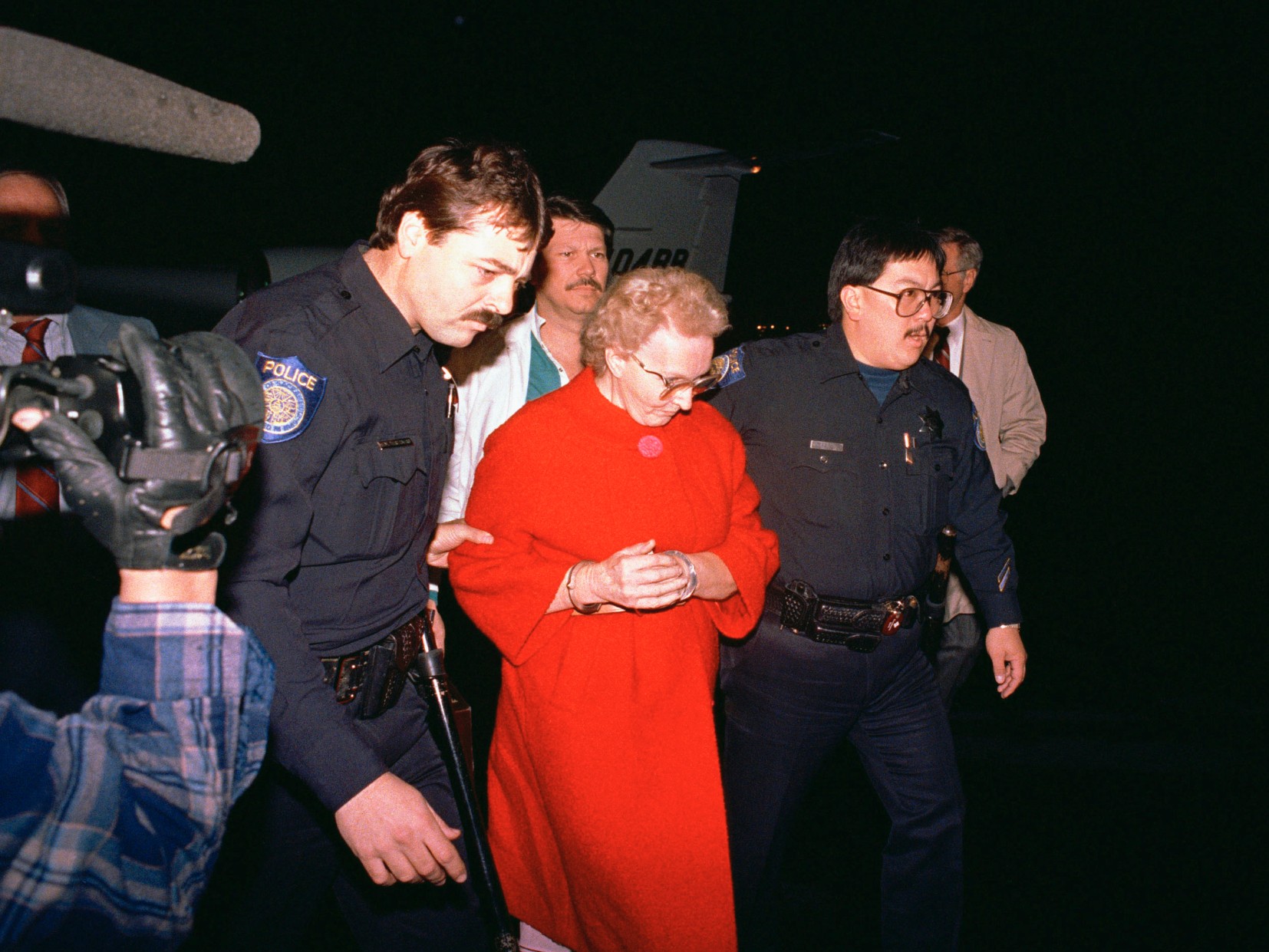
Puente fled.
She was arrested in Los Angeles days later after a citizen recognized her from a television news report.
The checks kept coming after the tenants were gone.
The signatures were forged.
The rooms were rented again.
The social worker's report was the first official alarm.
It took years for anyone to ask where the elderly and disabled tenants had gone.
It took a single missing-person report to open the ground.
Puente ran the house.
The disappearances ran through it like a ledger.
THE TRIAL: TWO STORIES
The trial opened in 1991 and ran for months.
The prosecution charged Puente with nine counts of murder.
Seven bodies had been recovered from the yard.
That gap — nine charges, seven remains — hung over the proceedings from the first day.
Forensic experts testified for the prosecution.
They said they found traces of the sedative Dalmane in exhumed remains.
The drug could incapacitate, the testimony suggested.
It could make a struggling person still.
What the sedative did in each specific death is not established in the record.
The defense told a different story.
Puente's attorneys argued the tenants died of natural causes or accidents.
They called witnesses who testified that Puente was a caring landlady.
She had a history of fraud, they conceded.
Fraud, they argued, is not murder.
The prosecution countered with the drug evidence.
They countered with the pattern of forged checks.
They countered with the sheer number of tenants who vanished from one small house.
Two stories, each plausible in a courtroom.
One is grounded in chemical traces and a ledger of disappearances.
The other rests on character testimony and the ordinary frailty of old age.
Which story is more credible?
Which one explains seven bodies in a backyard?
That would require evidence, and the evidence pointed in two directions.
THE VERDICT: SIX COUNTS, ONE COMPROMISE
The forensics were precise on the stand.
Traces of the sedative Dalmane, found in remains exhumed from the backyard, were presented as the link between the bodies and the accused.
The prosecution argued that the drug was the mechanism, the proof of intent.
The defence offered another reading.
Natural causes, accidents, a woman who was a fraudster but not a killer.
In August 1991, the jury returned.
Three counts of first-degree murder: guilty.
Six counts of first-degree murder: not guilty.
Why the split?
The acquittals were reportedly due to insufficient evidence on those specific victims.
That is the record.
The specific reasons for each acquittal are not detailed in the source.
The sedative trace was compelling, but it did not convince the jury on all counts.
It was a key piece of evidence.
It was not a complete narrative for every body in the ground.
The verdict was seen as a compromise.
The prosecution expressed disappointment.
They accepted the life sentence.
The trial judge sentenced her to life in prison without the possibility of parole.
Three bodies were enough for a conviction.
Seven bodies were found.
That is the arithmetic of the courtroom, not the yard.
Which story is more credible?
Which evidence was missing for the other six?
That would require a breakdown of the deliberations, and the record does not provide one.
AND THE STORY STILL ISN'T OVER
Dorothea Puente died in prison on March 27, 2011, at the age of 82, of natural causes.
She never confessed.
She maintained her innocence to the end.
The F Street house was later demolished.
The soil that gave up seven bodies is now a different ground.
Several victims' families have spoken publicly about the loss.
They have spoken about the difficulty of getting authorities to act on missing-person reports.
They have spoken about years of silence where a call should have been answered.
No other suspects were ever charged.
That remains a fact of the record.
That remains a question the record does not answer.
What happened inside those rooms, in the years between 1982 and 1988, was never fully told in court.
The jury heard the forensic testimony about the sedative trace in some remains.
The jury heard the defense argue the deaths were natural or accidental.
The jury heard the prosecution present the pattern of forged checks.
What the jury did not hear was a complete accounting.
The full truth of what happened at 1426 F Street remains unknown.
That is not a theory.
That is the plain state of the record.
She took her version of events with her.
The families carry theirs.
The house is gone.
The questions are not.
Advertisement
You may also like

The truck painter who led detectives to 49 Green River victims — and the DNA that closed in on him
He painted trucks for a living. Gary Leon Ridgway lived in Auburn, Washington, a suburb south of Seattle. He was married multiple times. He…
The 1939 tip that put a suspect behind bars — but the murder charge never came
1939. A tip. A tip put a former bartender and carnival worker behind bars in Cleveland, Ohio. He was the most prominent suspect in…
The Zodiac cipher that cracked open a killer's boast — but not his name
In August 1969, a cipher arrived at the offices of the *San Francisco Chronicle*. It was not the first taunting letter, and it would…
The smiley-face letter that made a sister call police on her own brother
The letter arrived at the Oregonian with a claim of responsibility for a murder and a mocking of police. It was signed with a…
The 2005 massage-table complaint that opened Epstein's case, and the detective who kept digging
A mother called Palm Beach police in 2005. She said her 14-year-old stepdaughter had been recruited by an older girl to give a man…
The 13-day trial that hinged on a dress burned in a stove — and a timeline no one could explain
The dress was burned in a stove on the third day after the bodies were found at 92 Second Street. The prosecution called it…