A wedding ring left on the dresser — and the confession that followed it
The ring sat on the bedroom dresser.
Shanann Watts had returned home that morning, August 13, 2018, from a business trip to Arizona.
Her husband, Christopher Watts, told police she was missing.
Officers found her purse in the house.
They found her phone in the house.
They found her wedding ring on the dresser — unusual for a woman who reportedly never removed it.
The ring was a detail that stood out to investigators early.
This was still a missing-persons case then.
Not a crime scene.
Not yet.
Why the ring was left on the dresser is not established in the record.
She was a woman who wore it always, and it was there, waiting, on the wood.
The house was quiet.
The beds were made.
The ring did not move.
No weapon was ever used in what followed; Watts later confessed to strangling Shanann and smothering their daughters.
But that confession came days later.
On August 13, the only evidence of wrongness was a purse, a phone, and a ring where it should not have been.
A woman who never took it off had taken it off.
That was the first crack.
That was the detail that stayed with the officers who walked through the rooms.
The ring was on the dresser.
That is all the record can say.
THE MISSING-PERSONS CASE
The search began as a missing-persons case.
Shanann's friend, who had been in contact with her, alerted authorities.
Officers walked through the house on August 13, 2018.
They found Shanann's purse and her phone.
They found her wedding ring on the bedroom dresser.
The ring was unusual for a woman who reportedly never removed it.
Watts failed a polygraph test.
The lead detective confronted Watts with inconsistencies.
Watts eventually confessed.
The confession was recorded.
Watts led investigators to the oil field site owned by his employer, Anadarko Petroleum.
The girls' bodies were found in oil tanks.
Shanann's body was found in a shallow grave nearby.
The exact timeline of the investigation is not in the source.
What is in the source is the order of the finding: the ring first, then the confession, then the site.
The search that began as a missing-persons case had turned into something far darker.
Not because of a theory.
Because of what the officers found when Watts led them there.

THE CONFESSION AND THE CHARGES
The arrest came on August 15, 2018.
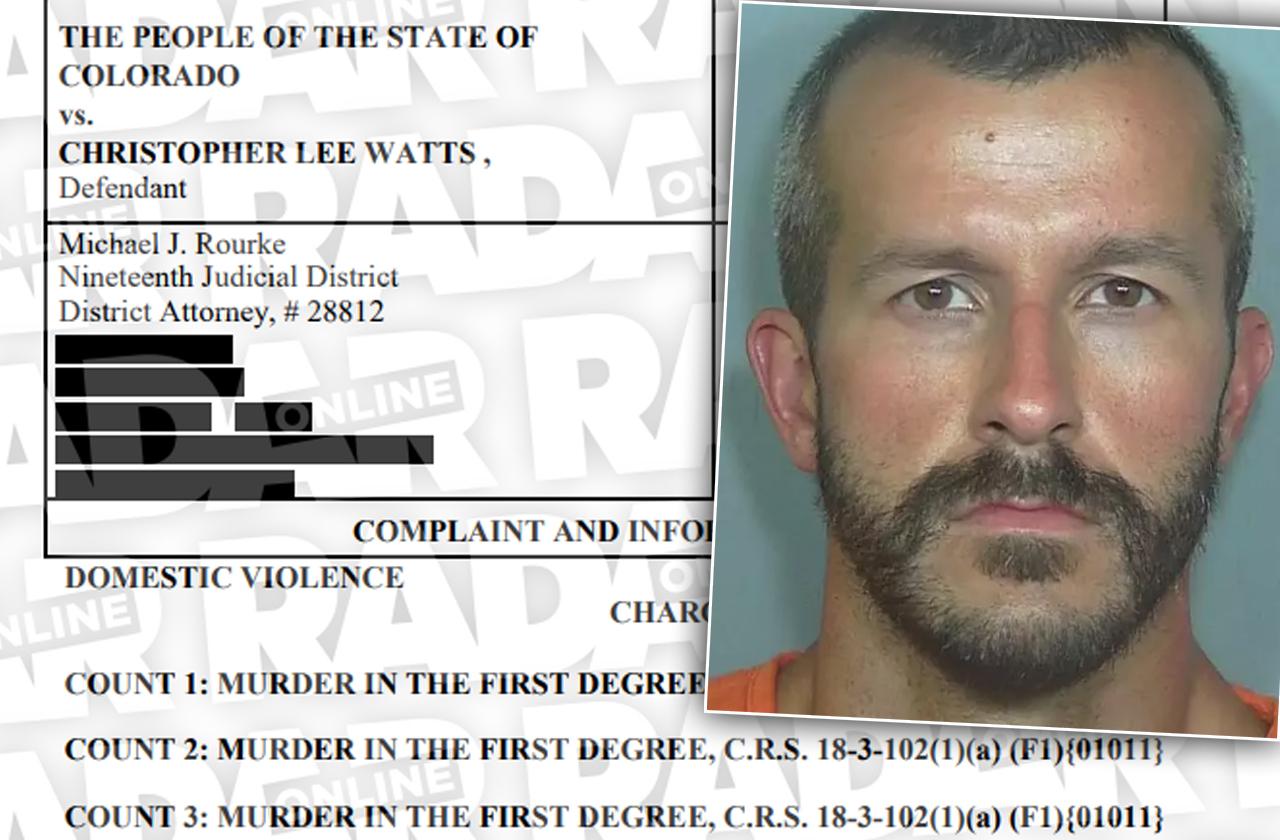
Watts was charged with three counts of first-degree murder and other offenses.
The confession was recorded.
It was later played at his sentencing hearing.
In November 2018, Watts pleaded guilty to all charges.
Three counts of first-degree murder.
Two counts of unlawful termination of a pregnancy.
Three counts of tampering with a deceased human body.
In exchange for the guilty plea, prosecutors agreed not to seek the death penalty.
The judge accepted the plea.
On November 19, 2018, the judge sentenced Watts to life in prison without the possibility of parole on the murder counts.
The other charges carried additional consecutive sentences.
The judge's name is not in the record.
Watts did not appeal.
There would be no trial.
There would be no jury.
There would be no second version of events tested in open court.
The plea made the confession the center of the record.
The sentence made the outcome final.
Life without parole means no hearing, no date, no end.
Watts is incarcerated at the Dodge Correctional Institution in Waupun, Wisconsin.
The case is closed.
No pending appeals.
No parole hearings.
The weight of a guilty plea is that it stops the questions.
The finality of the sentence is that it answers the only one that mattered.
THE TWO STORIES OF THE SAME FACTS
There are two stories that can be told from these same facts.
The prosecution’s story was built on Watts’s confession, physical evidence at the scene, and phone and GPS data.
That story ended with a guilty plea and a life sentence.
The other story is the one the record does not contain.
Watts’s defense was represented by public defenders, but the record does not include a detailed defense narrative.
Why he confessed, what his state of mind was — the record does not explain that.
He confessed, and the confession was recorded and played at his sentencing hearing.
That is the central piece of evidence.
It is also the one that remains the least explained.
Watts’s mistress, Nichol Kessinger, was questioned by police.
She was not charged with any crime.
Her account is in the public record only as far as the investigation used it.
Shanann’s parents and Christopher’s parents were prominent in coverage of the case.
The record does not include their interpretations of the events.

They spoke publicly about grief and about the case, but their inner accounts of what happened are not part of the documented record.
Any alternative explanation for the murders is not in the record.
The viral theories that circulate online are theories.
The record does not establish them.
It does not resolve them, either.
It establishes a confession, physical evidence, and data from a phone and a GPS.
It establishes a guilty plea and a sentence of life without parole.
What it does not establish is why.
Why a man would confess.
Why he would kill.
Why the ring stayed on the dresser.
That would require evidence the record does not provide.
The prosecution’s case was built on what could be proven.
The rest is a gap.
AND THE STORY STILL ISN'T OVER
Christopher Watts is incarcerated at the Dodge Correctional Institution in Waupun, Wisconsin.
He is serving life without parole.
The sentence carries no possibility of parole, and the case remains closed.
There are no pending appeals.
There are no parole hearings scheduled.
Any future legal proceedings are not in the record.
He has been the subject of multiple documentaries and true-crime programs.
He has not given any interviews from prison.
The cameras came, the producers left, and Watts stayed where he is.
Shanann's parents, Frank and Sandra Rzucek, have spoken publicly about their grief.
They have been involved in raising awareness about domestic violence.
That work continues.
They have also been involved in legal disputes over Shanann's estate and personal belongings.
Those disputes are part of the aftermath.
The house in Frederick where the murders occurred was sold at auction in 2019.
Someone else lives there now.
The rooms are the same.
The record does not say what they feel about that.
It is a closed case.
It is also an open wound.
The confession is on tape.
The bodies were found.
The sentence was pronounced.
None of that brings back the dead.
The family carries what the record cannot hold.
The case is finished.
The grief is not.
Advertisement
You may also like
The tarot card left at a D.C. sniper crime scene that said 'Call me God'
The card was on the ground at a crime scene in Montgomery County. A tarot card, face up, with a message written across it:…
The cell phone records that placed a suspect near Leakin Park — but one witness kept changing his story
January 13, 1999, was a school day. Hae Min Lee, an 18-year-old senior at Woodlawn High School in Baltimore County, Maryland, was last seen…
The parole agent who saw a sketch and stopped a car — then Polly Klaas's killer led police to her body
The parole agent saw the car first. A sketch, a tip, and a car on the road — that was the break. On November…
The cellmate tip that cracked the Clutter case after investigators ignored a footprint
The footprint was there on the night of November 15, 1959, inside the farmhouse near Holcomb, Kansas. Four members of the Clutter family were…
The cell tower records that placed Adnan Syed at Leakin Park — and the witness who changed his story
The phone call came on February 12, 1999. Baltimore County police picked up an anonymous tip that day, and the voice on the line…
The jailhouse informant's testimony that could not save Casey Anthony
She sat in the witness box and testified that Casey Anthony had made incriminating statements while in jail. Her name was Robyn Adams, a…